





*Disclaimer: The written article is based on a summary of existing literature on the topic of infrared saunas. The article is for educational purposes and the information provided below cannot be taken as a promise to help with acute health problems or diseases.
The claims in the article are backed by 21 scientific references. All references are numbered. You can access the text of the reference by clicking on the number.
I've created this short blog post to explain the infrared sauna blood pressure link that's very substantial in the currently available science. Let's begin with some definitions and background information though, before moving on to the topic of infrared saunas:
Blood Pressure 101: What Is Blood Pressure And Why Does It Matter For Health?
Let's start with the basics:
Blood pressure readings such as "130/80 mmHg" really throw many people off because it sounds very complicated. And yet, blood pressure is pretty simple to understand (1; 2; 3).
Simply put, "blood pressure" is how much pressure your blood thrusts against your arteries. Arteries are the parts of the blood circulation that deliver blood rich in oxygen to your tissues after the blood passed through your lungs.
Then there are two terms often related to blood pressure, the "systolic blood pressure" and "diastolic blood pressure". Once again, these terms should not intimidate you. Systolic pressure is the pressure when measured when your heart contracts and diastolic pressure is measured when your heart muscles relax.
(As an interesting note, some people think the heart is not a "pump" in the traditional sense - I'll ignore that notion here (4; 5)).
Having "high blood pressure" thus means that the blood in your circulatory system exerts more pressure against your arteries either when your heart is pumping, or relaxing, or both. Coming back to the "130/80 mmHg" reading, the first number of 130 signifies the systolic pressure, and the second 80 number signifies the diastolic pressure.
Generally, if you have a systolic pressure of 140 and a diastolic pressure of 90 you're considered "mildly hypertense".
Next up, let's consider whyblood pressure matters for health:
Hypertension is not benign as it's one of the most important risk factors not only for heart and blood vessel disease but also other health conditions (6; 7; 8; 9; 10; 11; 12). With hypertension, the risk for several types of heart and blood vessel disease goes up, such as coronary heart disease, heart failure, stroke, but also overall type 2 diabetes, Alzheimer's disease, and kidney problems risk.
A lower blood pressure of 115/75 mmHg is usually best and literally halvesyour risk for cardiovascular disease compared to the barely normal 135/95. You'll therefore want to keep your blood pressure at lower levels. Fortunately, infrared saunas can help in that journey. Let's explore how infrared sauna and high blood pressure are a match made in heaven:
The Infrared Sauna High Blood Pressure Ace Card
Things are rarely extremely simple in medicine. Any health condition is rarely 100% genetic or 100% environmental and usually many different factors play a role.
And yet, the science linkinginfrared saunaand blood pressure couldn't be more straightforward! I'll explore the difference between short-term studies and longer-term studies. First up, short-term studies:
- In a 2018 study with 102 participants, one single sauna session at 73 degrees Celsius for 30 minutes was used. (13). 44% of the participants were female and 56% were male, which is a reasonable distribution. All participants had their blood pressure levels taken before the sauna session, during, and afterwards. The result? Participants lost 7 points on their systolic anddiastolic blood pressure, on average, after a sauna session compared to their previous readings. After 30 minutes, the systolic readings were stilllower than before the sauna session.
- During a 2019 study, the blood pressure response of 19 healthy adults was measured (14). Duringthe sauna session, both diastolic and systolic blood pressureincreased significantly, but after the session, it declinedsignificantly. A 25-minute sauna session was used with a 30-minute cool-off period.
- A 2012 study showed decreases in "vascular pressure", and decreases in both systolic and diastolic blood pressure when sauna use was combined with exercise (15).
- An older 1983 study also shows immediatereductions in blood pressure after a sauna session (16).
Then, there are a few longer-term sauna blood pressure studies:
- Within a very intricate 2017 study, participants were followed for a median period of almost 25 years (17). Several risk factors such as smoking and body weight were removed from the statistical analysis so that the effects of sauna bathing upon blood pressure could become clearer. The result was that with increasing weekly sauna sessions, the risk for hypertension dramaticallydeclined. Participants who used 2-3 sauna sessions per week had a 24% lower risk of getting hypertension. With 4-7 sessions per week, that risk was 46% lower compared to people who only used the sauna once per week.
- A Japanese 2013 study investigated the effect of repeatedfar-infrared sessions - called "Waon therapy" in Japanse - on hypertension (18). A 60-degree Celsius far infrared sauna was used for 15 minutes per day. Many parameters closely linked to heart disease improved, although blood pressure wasn't directly measured. Blood flow improvements were measured in an important artery and exercise capacity improved, while stress levels decreased. Many studies show that sauna therapy is safeif you're currently not symptomatic (19; 20; 21).
While I'd personally like to see much more long-term data on the(infrared) saunahigh blood pressure link, early results are verypromising.
I personally also prefer an infrared sauna compared to a normal model because you'll have a much more gentle experience while still reaping all the benefits of increasing your core body temperature, improving blood circulation, and feeling very relaxed. Access to an infrared sauna for your home is also much easier than a traditional sauna.
And, now that I've laid out the case for infrared saunas for lowering blood pressure, let's conclude:
Conclusion: Why Not Use That Ace Up Your Sleeve?
Infrared saunas are a blood pressure-lowering ace card. And the best thing is, the effects are immediate while also accumulating over time.
So, a higher frequency of sessions leads to lower blood pressure readings over time. And, because blood pressure is one of the best predictors of heart and blood vessel disease problems and heart and blood vessel disease problems are the number 1 cause of death in many countries, this opportunity is really golden.
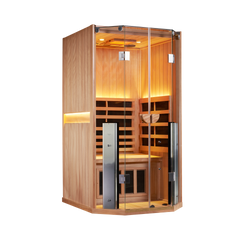
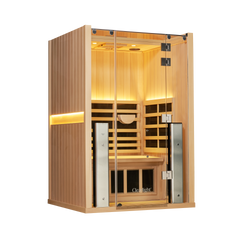
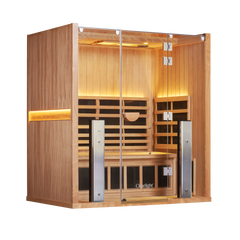
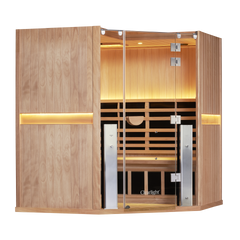
Make sure to check out our premium-quality infrared saunafor endless blood pressure-lowering benefits! Remember: in the long term, 4-7 sauna sessions per week cuts your hypertension risk in half!
Lastly, if you're interested then consider the page we created on infrared sauna benefits for circulation and heart health in general. Other sauna benefits are included on that page as well, such as diabetes support, detoxification through your skin and intestines, improvements in fat loss and metabolism, and much more.


